
Despite the mantra of politicians, associations and large masses of citizens, the energy transition, with the transition from oil sources to alternative sources such as solar, wind and the exploitation of marine currents, reality tells us that year after year the needs of oil grows and is destined to increase with the industrialization of a country that over time and will be its own industrial policy.

The reason for this difficulty is to be identified, fundamentally, in the fact that the transition is partly extremely high costs and in part it would not be sustainable with modern means.

Reading the data provided by international authorities, we find that the oil requirement in 2018 was over 99 million barrels, the highest ever.

We find out, according to some analysts, that we will exceed 100 million barrels in 2019.

The world oil reserves are represented on the map you see below.
Oil reserves
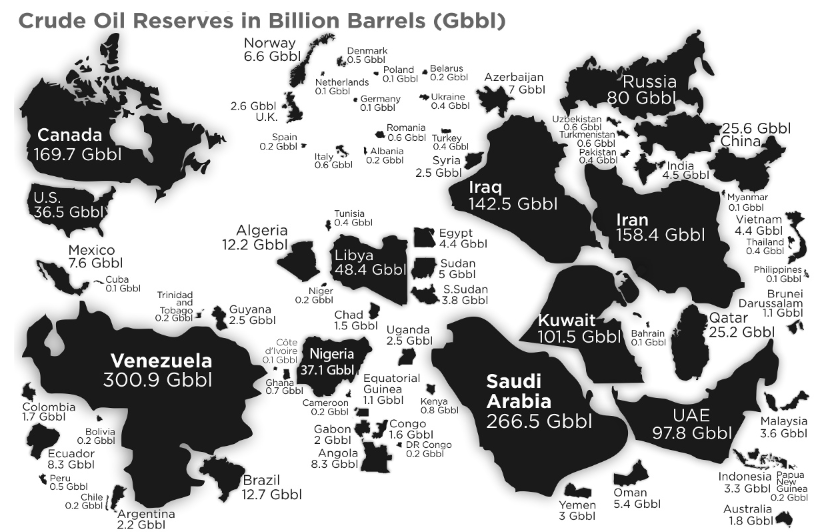
Surely many of you will be surprised to discover that Saudi Arabia is not the country with the largest oil reserves, but rather Venezuela, which also has huge reserves of other raw materials such as natural gas, bauxite, iron, coal, gold and uranium. Yes, Venezuela, which for years has been on the brink of default, is a country whose reserves could make its citizens rich but which, some domestic and international political dynamics have made very poor. Always from the infographic we understand that Canada is in third place for oil reserves. When we talk about oil fields, however, we need to understand that a very important factor is played by the conformation of the territory. With another infographic, in fact, we can understand how the cost of extraction from one country to another is very different.
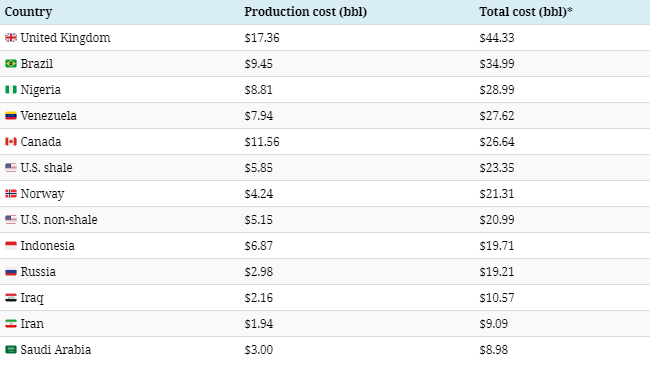
As is easy to understand, UK oil is the least convenient to extract with an average cost of USD 17 per barrel as well as Canada has an average cost of USD 11 and Venezuela of USD 8.

This makes it difficult to sell oil, especially if it is put in competition with crude from Saudi Arabia with 3 USD, Iran 2 USD, Iraq 2.16 USD or Russia with a cost of 3 USD.

It is clear, therefore, that although a country may have large oil reserves, in reality it may not be able to produce and sell that oil in order to maximize its potential benefit.

One can guess why, for example, the West is very keen on the Gulf countries, as that part of the world is the lowest cost source of supply available.

It is also for this reason that unlikely wars or alliances like the one with the Saudis are born.

If on the one hand the West makes wars to "export democracy", on the other it forges alliances with known dynasties for torture.

Returning to Venezuela, although little is talked about, it could be the powder keg of the next conflict between superpowers.

Sooner or later his natural reserves will enter into someone's geopolitical interest and then, in South America, the next war could arise.

Certainly it would have to be constantly monitored, to catch every minimum change in society or in politics or to capture possible interference by foreign subjects.

It will still take decades before humanity frees itself from the slavery of oil and from everything it has represented, including well-being and wars.

Probably the next war the men will fight for water, but meanwhile they continue to die for oil.

And oil is the cause of great wealth of few and enormous poverty and suffering of entire peoples.

On the subject of oil, it is recent news given by the Financial Times that, reporting the data of the EIA, has announced that the United States after several decades, in September, have exported, between oil and refined products, more than what was imported.

The main merit goes to refined products and shale oil, unconventional oil or Shale Oil, as it is defined, obtained through the fragmentation of bituminous shale rocks through pyrolysis, oxygenation or thermal dissolution.

In the coming years, at this rate, the United States could achieve energy independence and this eventuality could also affect different geopolitical balances.
